Best GameCube Games of All Time – Fans Must Play in 2026
Here is a truth that took the gaming world about fifteen years to fully accept:
The Nintendo GameCube had one of the greatest game libraries ever assembled on a single console.
When it launched in November 2001, Nintendo’s little purple lunchbox entered a marketplace that had fundamentally shifted. The PlayStation 2 was already dominant. The original Xbox brought Microsoft’s financial muscle into direct competition. The GameCube finished third in console sales during the sixth generation — a position that, for years, allowed critics and competitors to dismiss it as a commercial failure.
They were looking at the wrong numbers.
While the hardware sold roughly 21.7 million units — modest compared to the PS2’s 155 million — the software Nintendo and its partners produced for that hardware was extraordinary by any measurement. The GameCube era gave us some of the greatest individual game titles ever created. Legend of Zelda: The Wind Waker. Super Smash Bros. Melee. Metroid Prime. Resident Evil 4. Paper Mario: The Thousand-Year Door. These aren’t merely good games for their era — they are permanent landmarks in the medium’s history. If you enjoy classic multiplayer and nostalgic experiences, you should also explore our list of best co-op Switch games, where modern titles capture the same fun and teamwork that made older Nintendo games so memorable.
The best GCN games didn’t just push pixels. They pushed ideas. They redefined what their genres could be. They created experiences that players still talk about, still debate, still return to on original hardware or through the Dolphin emulator decades later.
This guide is your complete roadmap through that extraordinary library. We’re covering the greatest titles by genre, exploring what made each one special, examining their lasting legacy, and giving you everything you need to build the perfect GameCube collection — or simply understand why this overlooked purple box deserves every bit of reverence the gaming community has spent the last twenty years slowly, surely, gratefully extending to it.
Let’s start from the top.
Why the GameCube Library Deserves Serious Respect in 2026
Understanding the GameCube’s legacy requires separating commercial performance from creative achievement — two things that frequently have almost nothing to do with each other in gaming history.
Nintendo entered the sixth generation with a clear design philosophy: build hardware that serves developers, prioritize performance over multimedia features, and focus relentlessly on game quality over market positioning. The result was a console that lacked a DVD player (which meaningfully hurt PS2 competition during the DVD adoption boom), used proprietary mini-discs that limited third-party enthusiasm, and launched with a controller design that confused newcomers but rewarded dedicated players with extraordinary precision.
The games that emerged from those constraints were remarkable. Nintendo’s internal studios produced some of their finest work during the GameCube era — teams unencumbered by massive sales pressure, focused purely on creative excellence. Third-party developers who committed to the platform delivered ports and exclusives of exceptional quality. And several titles — Resident Evil 4, most dramatically — used the GameCube as the laboratory for design revolutions that would reshape their entire genre.
The retro gaming market has recognized this belatedly but enthusiastically. GameCube hardware and software prices have risen dramatically over the last decade. Common titles that sold for $5–$10 in 2010 now command $30–$60. Rare titles have appreciated into hundreds of dollars. The market is saying clearly what the sales charts obscured: this library was worth preserving.
What Makes a Great GameCube Game?
Before the ranked deep-dive, here’s the evaluation framework used throughout this guide:
Design Innovation: Did this game introduce mechanics, systems, or approaches that hadn’t been done before — or that were executed at a level that set a new standard for the medium? The best GameCube games didn’t just execute well — they pushed boundaries.
Replay Value and Longevity The GameCube era produced many games with extraordinary replay depth — titles that revealed new layers of strategy, content, or experience across multiple playthroughs. Long-term engagement matters as much as first impressions.
Multiplayer Excellence: The GameCube was, in many ways, the golden age of couch multiplayer gaming. Games that delivered extraordinary shared experiences receive appropriate weight in this assessment.
Technical and Artistic Achievement: What did this game do with GameCube hardware that was genuinely impressive? How did its artistic direction, music, and visual presentation serve the overall experience?
Cultural and Historical Impact: Has this game influenced the games that came after it? Is it still discussed, analyzed, and celebrated in gaming communities today? Impact across time reveals genuine greatness.
The Best GameCube Games Ever Made — Complete Ranked Guide
The Legendary Tier — Permanent Landmarks in Gaming History
The Legend of Zelda: The Wind Waker (2002)
Wind Waker arrived amid controversy and left as one of the most beloved games Nintendo ever produced. When its cel-shaded, cartoon-style visuals were first revealed in 2001, the reaction from a portion of the Zelda fanbase was hostile — many had hoped for a realistic continuation of Ocarina of Time’s aesthetic. Nintendo stayed the course. They were right to do so.
The Wind Waker’s visual style wasn’t a compromise. It was a vision. The cel-shading gave Link and his world an expressive range, an emotional warmth, and a timeless quality that photo-realistic graphics of the era cannot match today. The game still looks genuinely beautiful in 2026 in ways that its contemporaries with “realistic” graphics simply don’t.
But the visuals were only the surface. Beneath them was a Zelda game of extraordinary craft. The Great Sea — a vast ocean world connecting the game’s islands — created a sense of genuine adventure and discovery that the series hadn’t achieved since the original. Sailing across that sea, watching the dynamic sky and water react to time and weather, spotting a mysterious island on the horizon and deciding whether to investigate — it captured something essential about exploration that most games can only gesture toward.
The dungeon design was inventive throughout. The Forsaken Fortress. The Earth Temple. The Wind Temple. Each environment had a distinct identity, a logic of its own, and puzzles that rewarded environmental observation rather than arbitrary solutions. The Triforce Shard collection quest in the game’s final act drew criticism at launch for its pacing — criticism that the HD remake addressed — but even in its original form, Wind Waker’s highs were high enough to make it one of the three or four greatest Zelda games ever created.
Why it holds up: Wind Waker’s art direction makes it genuinely ageless. Its emotional storytelling — the relationship between Link and his grandmother, the tragedy of Ganondorf’s motivations, the bittersweet ending — hits harder with adult eyes than it did for many players who first experienced it as children.
Super Smash Bros. Melee (2001)
Melee is one of the most important fighting games ever made — full stop.
Released as a GameCube launch title in November 2001, Super Smash Bros. Melee was designed as a showcase for Nintendo’s new hardware. What it became was something Nintendo’s developers perhaps didn’t fully anticipate: the foundation of one of the most enduring competitive gaming communities in history, a game still actively played at major tournaments over two decades after release, and the gold standard against which every subsequent Smash game has been measured and — for a significant portion of the competitive community — found wanting.
The reasons for Melee’s enduring competitive relevance are mechanical. The game’s physics engine, developed by HAL Laboratory under Masahiro Sakurai, created a movement system of extraordinary depth — wavedashing, L-canceling, dashdancing, and a host of other advanced techniques emerged from the engine’s properties rather than intentional design. The result was a game where mechanical skill expression had essentially no ceiling. Players are still discovering optimizations and frame-perfect techniques in 2026..
But Melee wasn’t only for competitive players. Its Adventure Mode, its roster of 26 characters spanning Nintendo history, its Event Mode challenges, and its enormous trophy collection gave casual players dozens of hours of content. The game’s soundtrack, drawing on beloved Nintendo franchises from the NES era through the GameCube present, was a love letter to gaming history that resonated with anyone who grew up on Nintendo hardware.
Why it holds up: The annual EVO championship and various major fighting game tournaments continue to feature Melee competition decades after release. No other fighting game in history has maintained competitive relevance this long. The skill ceiling is genuinely infinite.
Metroid Prime (2002)
Metroid Prime is the greatest argument in gaming history that genre reinvention, executed brilliantly, produces better results than genre refinement.
The classic Metroid formula — exploration-driven progression through interconnected environments, ability unlocks expanding accessible areas, atmospheric isolation — had been executed in 2D for fifteen years before Retro Studios attempted the radical proposition of translating it into a first-person perspective. The gaming press was skeptical. Many longtime Metroid fans were alarmed. The concept seemed designed to erase everything that made Metroid distinctive.
What emerged was a masterpiece of environmental storytelling and atmospheric game design that stands among the finest games Nintendo has ever published.
Metroid Prime’s first-person perspective didn’t diminish the exploratory experience — it deepened it immeasurably. Exploring Tallon IV from inside Samus’s visor created intimacy with the environment that no third-person camera could achieve. The scan system, which allowed players to examine every surface, creature, and piece of architecture for lore entries, rewarded curiosity with rich narrative context delivered entirely through environmental discovery rather than cutscenes. Players who engaged with the scan system deeply uncovered a tragic backstory of Chozo civilization and Phazon corruption that rivaled the richest science fiction worldbuilding of the era.
The ability progression system — the true heart of any Metroid game — was designed with exceptional care. Each new item didn’t just open new paths; it changed how traversal felt. The Grapple Beam. The Spider Ball. The Gravity Suit. Every acquisition expanded both the player’s physical options and their understanding of how the interconnected world could be navigated.
Why it holds up: Metroid Prime’s environmental design is a masterclass in game world construction that game design programs still study. Its atmosphere remains unmatched in the first-person genre.
Resident Evil 4 (2005)
If any single game can be credited with changing the trajectory of an entire genre, Resident Evil 4 is that game.
Originally a GameCube exclusive (subsequently ported broadly to virtually every platform ever manufactured), RE4 didn’t just reinvent the Resident Evil series — it invented the over-the-shoulder third-person action-shooter camera perspective that became the dominant design template for action games from 2005 through the present day. The games that followed RE4’s template include The Last of Us, Gears of War, Dead Space, and hundreds of other titles. Understanding RE4 is understanding the DNA of modern action gaming.
The game placed series protagonist Leon S. Kennedy in rural Spain, pursuing a cult that had kidnapped the President’s daughter. The setting, the enemies, and the tone were radical departures from the mansion-and-zombie formula that defined the series’ first three entries. Enemies that could dodge your shots. A village that attacked you collectively rather than as individual threats. A merchant with an upgrade economy that gave resource management genuine strategic depth. QuickTime events are integrated into cutscenes for dramatic effect. A briefcase inventory system that made resource organization a satisfying spatial puzzle.
Every design element was intentional and brilliantly executed. The pacing across RE4’s fifteen-to-twenty-hour campaign was exceptional — tension and spectacle alternated with genuine rhythm, never overwhelming players with sustained stress but never allowing complete relaxation either. The castle sections expanded the enemy variety and environmental puzzle design masterfully. The island finale escalated the action to set-piece heights that felt genuinely cinematic.
Why it holds up: Resident Evil 4 Remake (2023) demonstrated that the original’s design remains so strong that it could anchor a full modern reimagining. The original GameCube version remains essential for understanding where modern action game design came from.
Paper Mario: The Thousand-Year Door (2004)
Paper Mario: The Thousand-Year Door is the greatest RPG on the GameCube and one of the greatest RPGs Nintendo has ever published — a game of extraordinary charm, mechanical depth, and creative inventiveness that represents the Paper Mario series at its absolute peak.
The game followed Mario’s quest to collect Crystal Stars before a shadowy organization called the X-Nauts could use them to open the legendary Thousand-Year Door. The paper aesthetic — characters and environments rendered as if existing in a world of folded and layered paper — was used not merely as a visual gimmick but as an active gameplay mechanic. Mario could fold himself to slip through narrow passages, unfold into a boat to cross water, and roll into a tube to navigate pipes.
The turn-based combat system was the finest in the Paper Mario series — a framework of timed button presses that turned passive watching into active participation. Attack timing determined damage output. Defensive timing reduced incoming hits. The Audience mechanic, which filled the stage where battles took place with watching characters who reacted to combat quality, created a performance dynamic that gave mundane, random encounters genuine energy.
The partner system provided eight distinct companions with unique abilities for exploration and combat, each with enough personality to become a genuine fan favorite. The chapter structure — each section of the game sends Mario to a distinct environment with its own visual identity and narrative arc — kept the twenty-to-thirty-hour experience feeling varied and fresh throughout.
Why it holds up: Thousand-Year Door received an official Nintendo Switch remake in 2024 — over twenty years after its original release — confirming its status as a genuine classic that deserves to be experienced by every generation of Nintendo fans.
The Essential Tier — Must-Own GameCube Titles
Super Mario Sunshine (2002)
Super Mario Sunshine was Nintendo’s follow-up to Super Mario 64 — one of gaming history’s most impossible acts to follow — and it charted its own course with confidence and creativity.
Set on the tropical vacation island of Isle Delfino, where Mario arrives for a holiday only to be framed for pollution crimes and forced to clean the island using the FLUDD water-spraying device, Sunshine is committed fully to its beach resort premise. The result was one of the most visually cohesive Mario games ever made and one of the most mechanically interesting platformers in the series.
FLUDD — the Flash Liquidizer Ultra Dousing Device — transformed Mario’s movement vocabulary entirely. The hover nozzle provided extended airtime for precision platforming. The rocket nozzle launched Mario to extraordinary heights for exploration and secret hunting. The turbo nozzle enabled high-speed ground traversal that felt exhilarating in open environments. Mastering FLUDD’s different nozzle types gave Super Mario Sunshine a movement depth that rewarded dedicated players substantially.
The game’s controversial secret stages — abstract, FLUDD-free platforming challenges that stripped away all mechanical support and demanded pure precision — remain some of the most intensely satisfying platforming tests Nintendo has ever designed. Frustrating and brilliant in equal measure.
Why it holds up: Super Mario Sunshine’s aesthetic warmth, its distinctive FLUDD mechanics, and its gorgeous tropical environments give it a personality entirely its own within the Mario series. No other game feels quite like it.
The Legend of Zelda: Twilight Princess (2006)
Released at the very end of the GameCube’s lifecycle and simultaneously as a Wii launch title, Twilight Princess was Nintendo’s response to the fans who had wanted a darker, more realistic Zelda game since Ocarina of Time’s era.
It delivered that vision magnificently. Hyrule in Twilight Princess was expansive, atmospheric, and genuinely beautiful — a world that felt consequentially larger and more alive than any previous Zelda game had achieved. The story, which dealt with light and shadow worlds, an ancient usurper, and Link’s transformation into a wolf under twilight’s influence, was the most dramatically serious the mainline series had attempted.
The dungeon design in Twilight Princess is among the finest in Zelda history. The Lakebed Temple. The Arbiter’s Grounds. The City in the Sky. Each dungeon was a self-contained puzzle architecture of exceptional craft, rewarding environmental observation and item application with solutions that felt both satisfying and logical.
The Midna character — Link’s twilight companion — was one of Nintendo’s finest supporting characters, combining genuine personality, narrative depth, and an arc of surprising emotional resonance that elevated the overall storytelling significantly.
Luigi’s Mansion (2001)
Luigi’s Mansion was a GameCube launch title that took a risk: putting Nintendo’s perpetually second-fiddle character in the starring role of a game built around a mechanic — ghost-vacuuming — that had no precedent in the company’s library.
It was brilliant.
The game’s scope was modest — four mansion wings, roughly six to eight hours for a first playthrough — but everything within that scope was executed with exceptional polish. Luigi’s fearful personality, expressed through his humming, his nervous reactions to darkness, and his constant trembling, made him one of gaming’s most endearing protagonists. The ghost-catching mechanics — stunning with flashlight, capturing with vacuum while managing the struggle meter — gave individual encounters satisfying mechanical texture. The portrait ghosts, each with a unique personality and capture puzzle, were miniature character studies of genuine charm.
Luigi’s Mansion launched a franchise that continues today, but the original GameCube entry retains a distinct atmosphere — intimate, slightly eerie, genuinely funny — that subsequent entries haven’t fully recaptured.
F-Zero GX (2003)
F-Zero GX is the greatest racing game ever made on GameCube hardware and one of the most technically demanding racing games in Nintendo’s history — a blistering, uncompromising test of precision driving skill that remains unmatched in its genre for pure speed sensation.
Developed in collaboration with Sega’s Amusement Vision studio (the team behind the Daytona USA and Super Monkey Ball franchises), F-Zero GX pushed GameCube hardware to extremes that few other titles approached. Thirty vehicles were racing simultaneously at speeds that made the track barely distinguishable from a blur. A boost system that required careful energy management between speed and shield integrity. Track designs of extraordinary ambition — corkscrew tunnels, vertical walls, impossible curves.
The story mode, narrated in live-action cutscene sequences featuring Captain Falcon and other characters in gloriously campy performances, was a unique artifact of early 2000s gaming culture. The difficulty of Chapter 7 on Very Hard remains a rite of passage that dedicated players discuss with the reverence reserved for genuine accomplishment.
Why it holds up: No subsequent F-Zero game has been released, making GX the definitive final statement of the franchise. Its speed sensation genuinely cannot be replicated anywhere else.
Pikmin 2 (2004)
Pikmin 2 took the original Pikmin’s innovative real-time strategy concept and expanded it in virtually every dimension — more Pikmin types, more environments, an entirely new two-player battle mode, and crucially, the removal of the time limit that had stressed many players in the original.
The game cast Captain Olimar and his trainee, Louie, on a debt-repayment mission, collecting valuable objects from a world populated by Pikmin — small plant-animal hybrid creatures that followed Olimar’s commands and could be used to carry objects, defeat enemies, and destroy obstacles. Managing different Pikmin types — each with distinct abilities and vulnerabilities — across multiple simultaneously progressing objectives gave the game a genuine real-time strategy depth unusual for Nintendo’s typically accessible design philosophy.
The two-player Versus mode was a revelation — head-to-head competitive Pikmin management that created frantic, tactical experiences unlike anything else in the GameCube library.
Metroid Prime 2: Echoes (2004)
Metroid Prime 2 built on its predecessor’s foundation with a darker aesthetic, a light-and-dark world mechanic that added environmental complexity, and a multiplayer mode that represented a genuine addition to the GameCube’s versus gaming options.
The dark world of Aether — an alternate dimension corrupted by Ing alien forces where Samus’s health drained simply from existing in the environment — created sustained tension that the original Prime’s exploration hadn’t attempted. Managing transitions between light and dark worlds, using the alternate dimensions to bypass obstacles and access areas unavailable in the normal world, gave Prime 2 a structural complexity that rewarded methodical exploration.
The Ammo system — separate ammunition for Light and Dark Beam weapons that required management throughout — added a resource dimension the first game lacked, though some players found it restrictive in early game sections before sufficient ammo capacity upgrades were collected.
Best GameCube Multiplayer Games — Couch Gaming Gold

The GameCube era was arguably the last golden age of couch multiplayer gaming before online play began fragmenting local gaming culture. These titles represent the best of that irreplaceable experience.
Mario Kart: Double Dash!! (2003)
Double Dash occupies a unique position in the Mario Kart franchise — mechanically the most distinctive entry, with a two-character-per-kart system that no subsequent game in the series has replicated, and beloved by a fiercely loyal fanbase who consider it the peak of the series.
The two-character system required players to manage both their driver and their item-throwing partner simultaneously — cycling between characters, managing item inventories for both, and using character-specific special items that created team synergies unavailable in the series before or since. The strategic depth this added to a Mario Kart game was remarkable.
The LAN mode — which allowed up to 16 GameCubes to be networked for simultaneous 16-player races before online play was standard — created legendary gaming events at college dorms and gaming clubs that participants remember decades later.
Super Smash Bros. Melee (Multiplayer Focus)
Already discussed in the Legendary Tier, Melee’s four-player multiplayer deserves specific recognition. The combination of accessible entry-point mechanics and infinite skill expression ceiling made Melee capable of entertaining everyone from complete newcomers to tournament-level competitors in the same room simultaneously. That breadth is genuinely rare and genuinely valuable.
Mario Party 4, 5, and 6
The Mario Party series on GameCube delivered three substantial entries (4, 5, and 6) that refined the board-game-plus-minigame formula across the console’s lifespan. Mario Party 6 introduced a day/night cycle that changed board dynamics and minigame availability, representing the series’s most ambitious GameCube entry. For family and group gaming sessions, few experiences in the library matched Mario Party’s ability to generate shared moments of triumph, disaster, and hilarious chaos.
Kirby Air Ride (2003)
Kirby Air Ride is one of the most misunderstood games in Nintendo’s history. Dismissed by many reviewers at launch as too simple, it harbored a depth in its City Trial mode — a sandbox experience where players collected power-up items and upgraded vehicles over a set time period before competing in random challenges — that rewarded dedicated play with strategic complexity critics largely missed on first contact.
The single-stick control system (the only control input was the analog stick and one button) was a deliberate design choice that lowered the barrier to entry dramatically while demanding genuine skill mastery for competitive performance. Kirby Air Ride’s City Trial mode remains one of Nintendo’s most underappreciated multiplayer experiences.
Best GameCube RPGs — Deep and Rewarding
Tales of Symphonia (2004)
Tales of Symphonia is the finest third-party RPG on the GameCube and one of the greatest JRPGs of the entire sixth generation, regardless of platform.
The game followed Colette Brunel and her companions on a journey to regenerate a dying world — a premise that opened into a narrative of extraordinary complexity, featuring themes of discrimination, sacrifice, the cyclical nature of systemic oppression, and the cost of idealism confronting reality. The storytelling maturity surpassed most RPGs of its era and holds up remarkably well by contemporary standards.
The real-time battle system — the Tales series’ Linear Motion Battle System in its most refined classic form — gave Tales of Symphonia combat with genuine depth. Positioning, elemental weaknesses, combination attacks between party members, and the Unison Attack system created battles that felt active and engaging rather than passive. The four-player cooperative battle mode, where up to four players could simultaneously control party members in combat, was an extraordinary addition that made the game exceptional for groups.
At approximately 60 hours for a first playthrough with significant additional content available through New Game Plus and optional side quests, Tales of Symphonia offered exceptional value and replayability.
Skies of Arcadia Legends (2003)
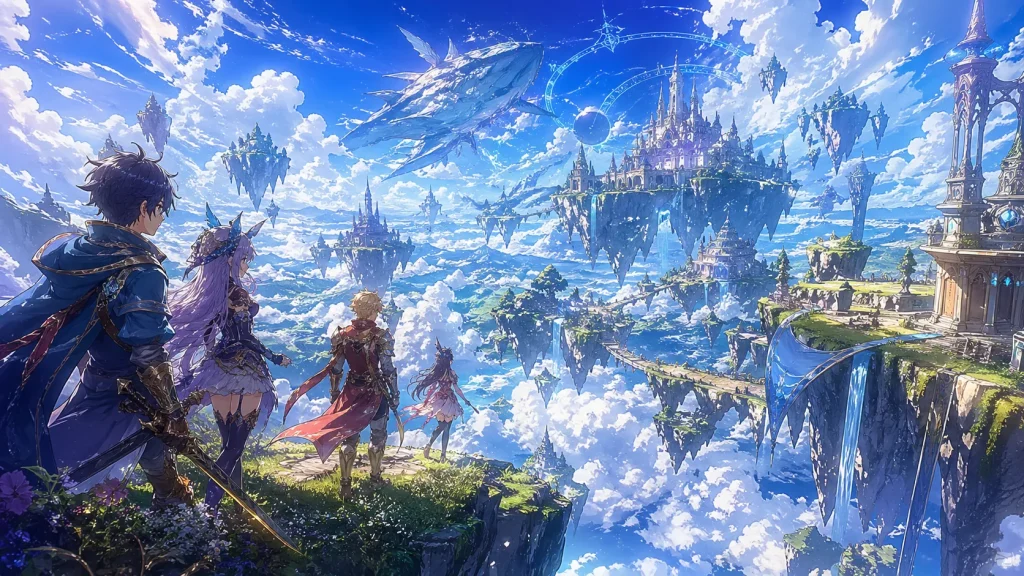
Originally released on the Dreamcast before receiving an enhanced GameCube port, Skies of Arcadia Legends is one of the most optimistic, adventurous, and genuinely joyful JRPGs ever created — a swashbuckling sky-pirate adventure that captured the essence of exploration-as-wonder with rare success.
The game’s world — a series of floating continents and islands above a cloud sea, navigated by airships — was one of the most inventive JRPG settings of its era. Discovering uncharted lands, hiring crew members for your ship, and upgrading your vessel created a sense of genuine seafaring adventure translated to a fantastical aerial context.
The ship-to-ship battle system, where naval combat between airships operated as a separate strategic layer from normal dungeon encounters, was inventive and satisfying. Skies of Arcadia Legends remains one of the GameCube’s most complete and emotionally rewarding RPG experiences.
Baten Kaitos: Eternal Wings and the Lost Ocean (2004)
Baten Kaitos was a GameCube exclusive JRPG with one of the most genuinely distinctive card-based combat systems in the genre’s history. Players assembled decks of “Magnus” cards representing attacks, items, and defensive options, drawing hands for battle and playing them in sequences that determined combat outcomes.
The game’s narrative — which featured one of the most genuinely unexpected story revelations in JRPG history — rewarded patient players with storytelling ambition that justified the investment. Baten Kaitos is consistently cited as one of the most underrated games in the GameCube library, a title that never received the attention it deserved commercially but has built a devoted fanbase in the decades since.
Best GameCube Action and Adventure Games

Resident Evil (REmake) (2002)
Before RE4 revolutionized the series’ action orientation, the GameCube received a complete, ground-up reconstruction of the original Resident Evil — a remake of such extraordinary quality that it has been commercially re-released multiple times across multiple generations and remains the definitive version of the game that launched survival horror as a genre.
The REmake preserved the original’s mansion layout and core narrative while rebuilding every visual element from scratch using the GameCube’s significantly superior hardware. The pre-rendered backgrounds achieved a level of atmospheric detail that the original’s PlayStation hardware couldn’t approach. New enemy types, new areas, new gameplay mechanics — including the Crimson Heads, which caused improperly disposed zombie corpses to reanimate as faster, more dangerous variants — deepened the original’s horror considerably.
The REmake is a masterclass in how to honor source material while meaningfully improving it. It remains essential not only as a GameCube title but as one of the finest survival horror games ever created.
Star Wars Rogue Squadron II: Rogue Leader (2001)
Rogue Leader was arguably the most technically impressive GameCube launch title — a Star Wars space combat game that reproduced iconic battles from the original trilogy with a visual fidelity that genuinely stunned players in 2001. The attack on the Death Star. The Battle of Hoth. The chaos of Endor. Each mission recreated beloved cinematic moments as playable, skill-tested experiences with remarkable accuracy and scale.
The flight model balanced accessibility with enough nuance to reward practiced players. The mission structure allowed both casual play-through enjoyment and dedicated pursuit of gold medal performance ratings. Rogue Leader demonstrated the GameCube’s hardware capabilities more dramatically than any other launch title.
Eternal Darkness: Sanity’s Requiem (2002)
Eternal Darkness is one of the most genuinely creative games Nintendo has ever published — a psychological horror epic with a sanity system that broke the fourth wall in ways that remain startling and inventive even today.
The game spanned twelve interconnected stories across 2,000 years of human history, with each playable character’s encounter with ancient cosmic horror contributing to an overarching narrative. The Sanity Meter — which depleted when characters witnessed supernatural events — triggered hallucinations when sufficiently low. Those hallucinations included fake game crashes, fake save-file deletion screens, muted volume effects, distorted room geometry, and other fourth-wall-breaking illusions designed to make players genuinely uncertain whether their console was malfunctioning.
In 2002, before widespread internet walkthroughs made surprise impossible, these sanity effects produced genuine shock. Players called Nintendo’s helpline asking if their game was broken. The system remains one of the most creative horror mechanics ever designed.
Why it holds up: Eternal Darkness is genuinely rare — a Nintendo-published mature horror game with creative ambition that the company has never revisited. Its sanity effects are permanently inventive regardless of era.
GameCube Hidden Gems — Overlooked Masterpieces

Viewtiful Joe (2003)
Viewtiful Joe was Capcom’s love letter to superhero cinema wrapped in one of the most stylistically distinctive action games of the GameCube era. The side-scrolling brawler presented its world as a movie, with the player-character Joe gaining the ability to slow time and speed it up — creating combat mechanics built around temporal manipulation that felt genuinely fresh.
The art style — bold cel-shading, dynamic camera angles, film grain and scratches on the “movie” presentation — was visually unlike anything else in the library. The difficulty was demanding in the classic Capcom tradition, but the moment-to-moment combat, with its time-manipulation combos and VFX power system, rewarded mastery with spectacular results.
Ikaruga (2003)
Ikaruga is one of the most mechanically pure and intellectually demanding shoot-’em-ups ever designed — a game built around a single mechanic of extraordinary elegance. Every element in Ikaruga is either black or white. Your ship toggles between black and white polarities. In white polarity, you absorb white bullets and deal extra damage to white enemies. In black polarity, the reverse applies.
This single mechanic generates a puzzle game disguised as a shooter — enemy patterns that must be read and responded to with specific polarity switches, boss encounters that become almost choreographic sequences of polarity management, and a skill ceiling so high that perfect chain runs (which involve precisely sequenced polarity switches to chain three same-colored enemies consecutively through an entire stage) have consumed thousands of hours of dedicated players’ lives.
Ikaruga is demanding to the point of excluding many players. For those willing to engage with its challenge, it is a transcendent mechanical achievement.
Beyond Good & Evil (2003)
Beyond Good & Evil is one of gaming’s most persistent “underseen masterpiece” discussions, and every element of that reputation is deserved. The game cast players as Jade — a photojournalist and martial artist investigating a government conspiracy on an alien-threatened planet — in an action-adventure that combined stealth, combat, photography-based puzzle solving, and hovercraft racing with rare narrative cohesion.
The conspiracy narrative was sophisticated for its era — a story about state-manufactured fear, media complicity, and the courage required to expose institutional deception that resonated with adult players in ways most video game stories couldn’t attempt. Jade herself was one of gaming’s finest female protagonists — competent, caring, and defined by her relationships rather than by her combat capabilities.
Beyond Good & Evil sold modestly at launch but has maintained a passionate fanbase for over twenty years. A sequel has been in development for years — testament to the enduring love the original inspires.
How to Play the Best GameCube Games in 2026
The GameCube library is accessible through several paths, each with distinct advantages.
Original Hardware GameCube consoles remain widely available through retro game stores and online marketplaces. Prices have risen — expect $80–$150 for a working console in good condition. The original GameCube controller remains one of gaming’s finest input devices and is worth seeking out specifically. Note that the GameCube requires a standard definition television or an HDMI adapter for modern display connections.
Wii Backward Compatibility Original Nintendo Wii consoles (not Wii Mini) play GameCube games natively using original GameCube discs and controllers. A Wii can be found for significantly less than a GameCube while providing access to the full GameCube library alongside the Wii’s own substantial software catalog.
Dolphin Emulator The Dolphin emulator for PC provides GameCube and Wii emulation of exceptional accuracy and adds modern enhancements, including higher resolutions, widescreen support, anti-aliasing, and online multiplayer. For players who own physical GameCube software, Dolphin provides access to that library on modern hardware with substantial visual improvements over original hardware output. When playing older games on modern systems, you might occasionally run into performance or launch issues. If that happens, our guide on Steam 2 Error Code Fix can help you understand common launch and server-related problems that affect many PC gaming setups.
Nintendo Switch Online + Expansion Pack Nintendo has begun adding select GameCube titles to the Switch Online service’s Expansion Pack tier, with titles like F-Zero GX and Luigi’s Mansion available to subscribers. The catalog continues to grow.
Building a GameCube Collection — Where to Start
The GameCube library rewards strategic collection building. Here’s a prioritized approach:
For the essential five that every GameCube collection needs, start with Super Smash Bros. Melee, The Legend of Zelda: The Wind Waker, Metroid Prime, Resident Evil 4, and Paper Mario: The Thousand-Year Door. These five games represent the library’s absolute peak and cover platformer, action-adventure, first-person exploration, horror action, and RPG genres, respectively.
For expanded genre coverage, add Mario Kart: Double Dash!! for racing, Tales of Symphonia for JRPG depth, F-Zero GX for technical racing mastery, Luigi’s Mansion for atmosphere, and Super Mario Sunshine for platformer variety.
For hidden gems that consistently surprise new players, Viewtiful Joe, Beyond Good & Evil, Eternal Darkness, and Skies of Arcadia Legends are the titles most likely to produce the “how did I miss this?” response.
GameCube vs. PlayStation 2 — The Library Comparison
The honest assessment of GameCube vs. PS2 as game libraries reveals a nuanced picture.
The PS2’s library was vastly larger — over 4,000 titles compared to GameCube’s roughly 650. In breadth and genre coverage, PS2 was comprehensively superior. For players who wanted the widest possible selection, the choice wasn’t genuinely competitive.
But in terms of peak quality — the absolute finest individual games on each platform — the GameCube held its ground surprisingly well. Nintendo’s first-party output during the GameCube era was exceptional even by Nintendo’s elevated standards. And specific third-party titles — Resident Evil 4, Tales of Symphonia, Skies of Arcadia Legends — chose the GameCube as their primary or exclusive platform for development reasons, producing versions of exceptional quality.
The genuine truth: PS2 had more games. The GameCube had a higher proportion of outstanding ones. Both platforms deserve space in any serious retro collection.
Final Word: The Purple Lunchbox Deserves Its Flowers
The Nintendo GameCube lost the sales war of the sixth console generation. That is an objective fact of commercial history.
Everything else about the GameCube’s legacy is a different story entirely.
The best GameCube games were produced by developers operating at the absolute peak of their creative powers — Nintendo’s internal studios delivering some of the finest work in the company’s history, third-party partners producing experiences that used the hardware’s capabilities with genuine artistry. The result was a library that packs more genuine masterpieces into roughly 650 titles than most platforms achieve across twice as many releases.
In 2026, the GameCube’s reputation had been almost completely rehabilitated. What was once dismissed as a commercial disappointment is now recognized as a creative triumph — a console that prioritized game quality above all else and built a library that rewards exploration, collection, and repeated play more generously than almost any platform before or since.
The purple lunchbox didn’t win. But what does it make? That lives forever.
Whether you prefer retro classics or modern multiplayer titles, gaming today offers more variety than ever. For newer online gaming experiences, you can also explore our troubleshooting guides like Marvel Rivals Error Code 220 fixes, which help keep your sessions smooth and frustration-free.