Cybersecurity Banking Staffing Solutions in 2026
In 2026, a cyberattack on a bank is no longer a question of if; it is a question of when, how severe, and how prepared your team is to respond. Financial institutions are among the most targeted sectors globally, facing threats ranging from ransomware and state-sponsored intrusions to insider fraud and supply chain compromises.
Yet the most dangerous vulnerability many banks carry today is not a misconfigured firewall or an unpatched server. It is a talent gap.
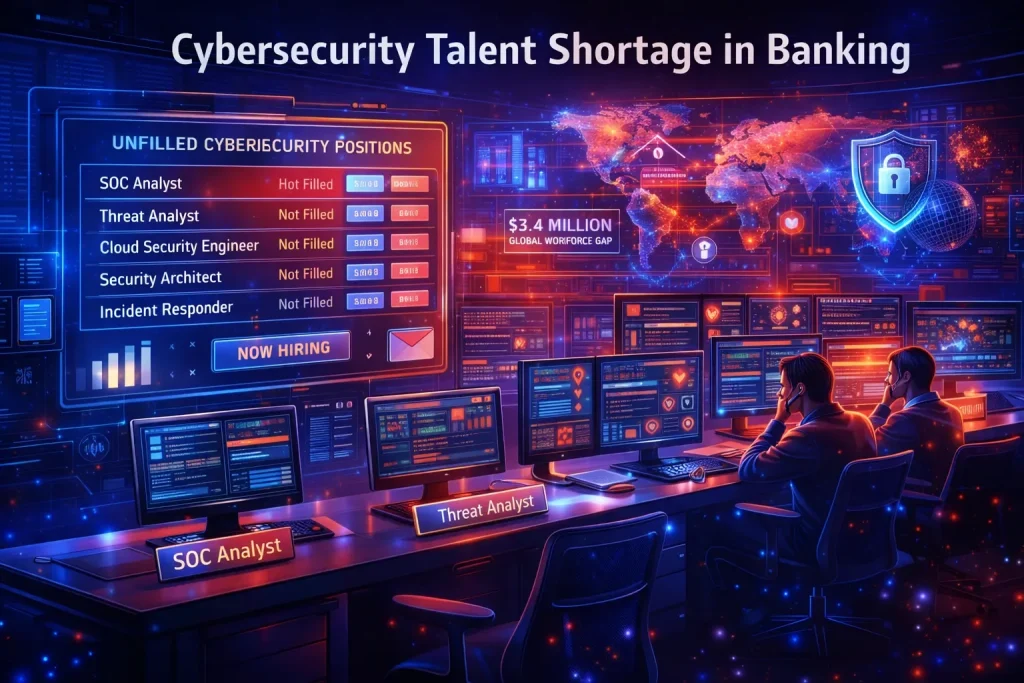
According to the ISC2 Cybersecurity Workforce Study, the global cybersecurity workforce shortage has surpassed 4 million professionals. Within financial services, this shortage is acute. Banks are competing not just with each other, but with technology firms, defense contractors, and government agencies — all hunting the same rare pool of qualified cybersecurity talent.
| For decision-makers charged with digital resilience, HR professionals navigating skill shortages, and cybersecurity professionals building their careers in banking, understanding the modern landscape of cybersecurity banking staffing solutions is no longer optional. It is a strategic imperative. |
Why Cybersecurity Hiring in Banking Is Uniquely Complex
Banking is not like other industries. Cybersecurity professionals who thrive in financial services need a rare combination: deep technical expertise layered over a nuanced understanding of financial regulation, compliance frameworks, and sector-specific risk.
Regulatory Pressure Creates Specialized Demand
Banks operate under a dense web of compliance obligations — PCI DSS, SOC 2, DORA (Digital Operational Resilience Act in the EU), FFIEC guidelines, and NYDFS Cybersecurity Regulation in New York, among others. This creates demand for professionals who are not just technically skilled, but also compliance-literate.
A penetration tester hired from a tech startup may excel at finding vulnerabilities, but if they lack familiarity with how those findings map to a bank examiner’s expectations, their value is diminished. Banking cybersecurity staffing solutions must account for this dual fluency.
The Threat Surface Is Expanding Rapidly
Cloud migration, open banking APIs, real-time payment systems, and the proliferation of fintech partnerships have dramatically expanded the attack surface for financial institutions. This demands professionals with expertise across cloud security, API security, zero-trust architecture, and third-party risk management — specializations that are in extremely short supply.
Compensation Expectations Are Rising
Top-tier cybersecurity professionals in banking command salaries that frequently exceed $200,000 for senior roles, with CISOs at major institutions often earning well above that threshold when total compensation is factored in. Banks that do not align their compensation benchmarks with market reality will consistently lose candidates to competitors who will.
The Core Components of an Effective Cybersecurity Staffing Strategy
Banks that consistently attract and retain top security talent do not leave hiring to chance. They build deliberate, multi-layered staffing strategies that address both immediate needs and long-term talent pipeline development.
1. Define Role Profiles With Precision
Generic job descriptions produce generic applicant pools. Before opening a requisition, hiring teams should work directly with security leadership to map exact responsibilities, required certifications, technology stack experience, and regulatory knowledge.
For example, a Security Operations Center (SOC) analyst role at a Tier 1 bank should specify whether the candidate needs SIEM experience with Splunk or Microsoft Sentinel, familiarity with SWIFT security controls, and comfort working within a 24/7 shift rotation. The more specific the role profile, the more efficiently the pipeline screens for genuine fit.
| Pro Tip: Involve your current top performers in role definition. They understand the actual day-to-day demands better than any job description template. |
2. Partner With Specialized Cybersecurity Staffing Firms
General-purpose recruiting firms rarely have the depth to source niche cybersecurity talent within the banking sector. Specialized cybersecurity banking staffing solutions providers maintain curated networks of vetted professionals — including passive candidates who are not actively job-searching but are open to the right opportunity.
These firms understand the difference between a security architect who knows financial messaging protocols and one who does not. That granular domain knowledge shortens time-to-hire significantly and reduces costly mis-hires.
When evaluating staffing partners, assess them on three dimensions: their demonstrated network within financial services cybersecurity, their understanding of your regulatory environment, and their ability to provide both contingent and permanent placement options.
3. Build an Internal Talent Pipeline Through Upskilling
The fastest growing banks in cybersecurity maturity are not solely relying on external hires. They are investing in developing talent from within — rotating high-potential IT and compliance professionals into cybersecurity roles with structured training, mentorship, and certification sponsorship.
Programs supporting CISSP, CISM, CEH, and cloud security certifications like AWS Security Specialty or Microsoft AZ-500 represent relatively modest investments compared to the cost of an unfilled senior security role.
| Banks that fund cybersecurity certifications report meaningfully higher retention rates among security staff. Professionals who feel invested in are less likely to leave for competitors — even when offered higher base salaries. |
4. Leverage Hybrid and Contract Staffing Models
Not every cybersecurity need requires a full-time hire. A growing number of financial institutions are supplementing their permanent teams with highly skilled contractors for project-based work — penetration testing cycles, incident response readiness assessments, cloud migration security reviews, and regulatory audit preparation.
This flexible model allows banks to access specialist expertise on demand without the full overhead of permanent headcount, while keeping their core security team focused on ongoing operations.
The Most In-Demand Cybersecurity Roles in Banking for 2026
Understanding which skills are most critically needed allows HR teams and hiring managers to prioritize their recruitment efforts and compensation investments accordingly.
| Role | Key Skills Required | Demand Level |
|---|---|---|
| Cloud Security Architect | AWS/Azure security, zero-trust, IAM, CASB | Critical |
| Threat Intelligence Analyst | Dark web monitoring, STIX/TAXII, and financial threat actors | Very High |
| Application Security Engineer | SAST/DAST, API security, DevSecOps | High |
| Incident Response Lead | Forensics, SIEM, and regulatory notification procedures | Critical |
| Third-Party Risk Manager | Vendor assessments, TPRM frameworks, contractual controls | High |
| Identity & Access Management Specialist | PAM tools, SSO, MFA, AD security | High |
| Compliance-Focused Security Analyst | PCI DSS, DORA, FFIEC, NYDFS knowledge | Very High |
Sourcing Strategies That Actually Work in 2026
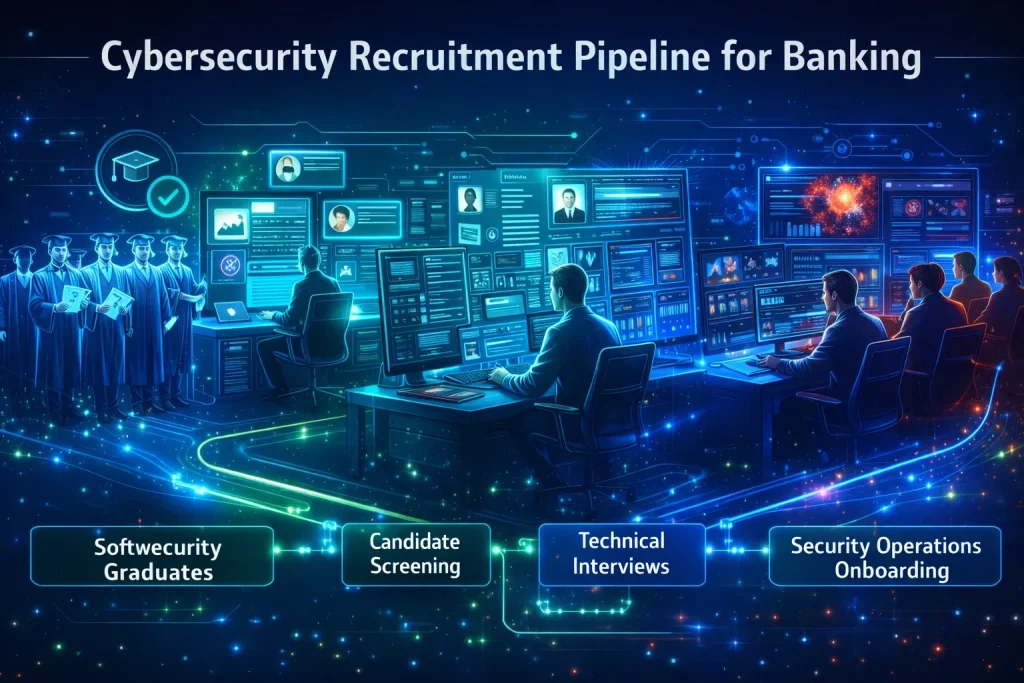
The days of posting a job description and waiting for applicants to arrive are over for cybersecurity roles in banking. Effective sourcing today is proactive, multi-channel, and relationship-driven.
Target Passive Candidates Through Professional Communities
The best cybersecurity professionals are rarely browsing job boards. They are active in ISAC communities (particularly FS-ISAC for financial services), presenting at conferences like RSA or Black Hat, contributing to open-source security projects, or holding leadership positions in professional bodies like ISACA.
Savvy hiring teams and their staffing partners build presence in these communities long before a role opens — engaging with content, sponsoring events, and cultivating relationships with potential future hires.
Use Technical Assessments That Reflect Real Work
Generic skills tests do not differentiate strong candidates from weak ones in specialized roles. Banks that get recruitment right use technical assessments designed around actual job scenarios — a simulated incident response exercise, a threat model review of a hypothetical banking API, or a code review targeting common financial application vulnerabilities.
This approach benefits both parties. Strong candidates appreciate the rigor, and banks gain a genuine signal on readiness rather than theoretical knowledge.
Build University and Bootcamp Partnerships
Forward-looking financial institutions are partnering with universities offering cybersecurity degree programs and intensive bootcamps to create structured early-career pipelines. Internship programs, sponsored research projects, and guest speaker arrangements build brand recognition among emerging talent at exactly the moment they are forming career preferences.
| Actionable Step: Identify two to three universities with strong cybersecurity programs in your region and formalize a partnership that includes annual internship slots, classroom engagement from your security team, and a defined pathway to full-time roles. |
Retention: The Hidden Half of the Staffing Equation
Cybersecurity banking staffing solutions are incomplete if they focus only on acquisition. Losing a skilled security professional costs organizations between 50% and 200% of that person’s annual salary when recruitment, onboarding, and productivity ramp-up costs are factored in.
Career Development Pathways Matter More Than You Think
Cybersecurity professionals consistently cite lack of advancement opportunities as a primary reason for leaving. Banks that articulate clear career ladders — from analyst to senior analyst to team lead to manager to CISO track — and that actively sponsor internal moves, retain their people far more effectively than those that leave advancement ambiguous.
Culture and Mission Resonate With Top Talent
The best security professionals are motivated by meaningful work. Banks that communicate the societal importance of protecting customer assets, enabling financial stability, and defending critical infrastructure connect with something deeper than salary. This narrative should be woven into employer branding, onboarding, and leadership communication.
Flexibility Has Become a Non-Negotiable
Post-2020 workforce expectations have permanently shifted. Many cybersecurity roles can be performed effectively in hybrid arrangements, and top candidates will increasingly decline offers that require full-time on-site presence without compelling justification. Banks need to assess which roles genuinely require physical presence and offer remote or hybrid flexibility where operationally feasible.
| One global bank reduced cybersecurity turnover by 34% over two years by implementing a structured hybrid policy, quarterly career development conversations, and an annual certification reimbursement program. These are not expensive initiatives — their ROI is substantial. |
Technology’s Role in Smarter Cybersecurity Hiring
Modern cybersecurity banking staffing solutions are increasingly augmented by technology — both to improve candidate sourcing and to assess fit more accurately.
AI-Assisted Sourcing and Screening
AI-powered talent platforms can scan professional networks, conference speaker databases, open-source contribution histories, and certification registries to identify candidates who match complex technical profiles. These tools dramatically reduce the time required to build an initial candidate pool for niche roles.
However, technology is a tool — not a replacement for judgment. Automated screens should be configured carefully to avoid filtering out strong candidates on superficial grounds, and human review must remain central to the process.
Skills-Based Hiring Frameworks
Many banks are moving away from credential-focused hiring toward skills-based frameworks that evaluate what a candidate can actually do. This approach opens the door to strong professionals who may lack traditional four-year degrees but possess deep practical expertise — particularly relevant for roles in threat intelligence and incident response.
What Top Cybersecurity Candidates Look for in Banking Employers
Understanding the hiring equation from the candidate’s perspective is essential for financial institutions that want to win competitive talent situations.
Top cybersecurity professionals evaluate banking employers on several dimensions:
- Access to sophisticated threat environments and complex security challenges that develop their skills
- Clear investment in their professional development, including conference attendance, training budgets, and certification support
- Leadership that understands security and treats the function as a strategic capability, not a cost center
- Competitive total compensation, including base salary, bonus, and equity or deferred compensation structures
- Mission alignment — the ability to say their work protects real people and contributes to financial system stability
- Flexible working arrangements that respect their life outside work
Banks that deliver on these dimensions win. Those that do not will continue to struggle with both attraction and retention, regardless of how much they spend on job advertising.
Building Cyber Resilience Starts With the Right People
No technology investment, compliance program, or vendor contract substitutes for having the right cybersecurity professionals in the right roles. In 2026, the financial institutions that achieve genuine cyber resilience will be those that treat talent strategy as inseparable from security strategy.
That means investing in specialized cybersecurity banking staffing solutions — whether through expert recruiting partnerships, internal talent development, flexible staffing models, or all three. It means building employer brands that resonate with security professionals. It means creating cultures where great people choose to stay.
The threat landscape will continue to evolve. The regulatory environment will grow more demanding. The technology stack will keep expanding. But teams built on deep expertise, strong culture, and deliberate development will navigate all of it.
| The banks that win on cybersecurity in 2026 and beyond will not be the ones with the most sophisticated tools. They will be the ones with the most capable, committed, and well-supported people behind those tools. |
Ready to Build Your Cybersecurity Team?
Whether you are addressing an immediate gap, building a long-term talent pipeline, or re-evaluating your entire security staffing strategy, the right partner makes a decisive difference. Connect with cybersecurity banking staffing specialists who understand both the technical demands of financial sector security and the realities of today’s talent market.
Your next great hire is out there. The question is whether your strategy is designed to find them before your competitors do.
Keywords: cybersecurity banking staffing solutions, bank cybersecurity hiring, financial services security talent, CISO recruitment, security staffing financial institutions, cybersecurity talent shortage banking, fintech security staffing 2026