
Will AI Replace Cybersecurity Jobs? The Real Truth in 2026
Artificial intelligence is no longer a future concept. It’s already triaging alerts in Security Operations Centers, writing detection rules, scanning codebases for vulnerabilities, and generating threat intelligence reports in seconds. If you work in cybersecurity — or you’re training to enter the field — the question isn’t abstract anymore: Is my job safe?
The honest answer isn’t a simple yes or no. It’s more nuanced, more industry-specific, and ultimately more optimistic than most fear-driven headlines suggest.
In this article, we break down exactly what AI is doing in cybersecurity right now in 2026, which roles are genuinely at risk, which are becoming more valuable, and what professionals and organizations should do about it. No hype. No panic. Just a clear-eyed look at where the industry is heading.Compare roles in software engineering vs cybersecurity .
The State of AI in Cybersecurity in 2026
AI has moved well beyond experimental deployment in cybersecurity. Enterprise security teams are actively using large language models, machine learning pipelines, and agentic AI systems across multiple functions.
Here’s what’s already happening at scale:
Threat detection and triage: AI models now process millions of security events per second, flagging anomalies that would take human analysts hours or days to identify manually. Tools like Microsoft Sentinel, CrowdStrike Falcon, and Darktrace use behavior-based AI to surface genuine threats from noise.
Vulnerability scanning and patch prioritization: AI systems scan infrastructure continuously, correlate CVE databases with actual asset exposure, and recommend prioritized remediation — a process that used to require a dedicated team.
Incident response automation: Playbook-driven AI can contain a compromised endpoint, revoke credentials, and isolate a network segment faster than any human can open a ticketing system.
Code security analysis: Tools like GitHub Copilot’s security features and Snyk’s AI engine review code in real time, catching insecure patterns before they reach production.
Report generation: Automated reporting tools now generate executive summaries, compliance documentation, and forensic timelines with minimal human input.
The capabilities are real. The efficiency gains are real. But does that mean human cybersecurity professionals are being phased out? Not quite.

What the Data Actually Says
The workforce data in 2026 tells a counterintuitive story.
Despite rapid AI adoption in security tooling, the cybersecurity talent gap has not closed — it has widened. The global shortfall of qualified cybersecurity professionals now exceeds 4 million unfilled positions, according to ISC2’s most recent workforce report. Organizations aren’t laying off security staff because AI has made them redundant. They’re struggling to find enough qualified people to manage, configure, and interpret the AI systems they’ve deployed.
This gap reflects something important: AI in cybersecurity is primarily an amplifier, not a replacement. It handles volume. It handles speed. But it doesn’t handle judgment, context, ambiguity, or accountability — and those are the core ingredients of effective security work.
The Roles Most at Risk of Automation
To be honest about the landscape, some cybersecurity roles are more vulnerable to AI displacement than others. Professionals in these areas need to take notice.
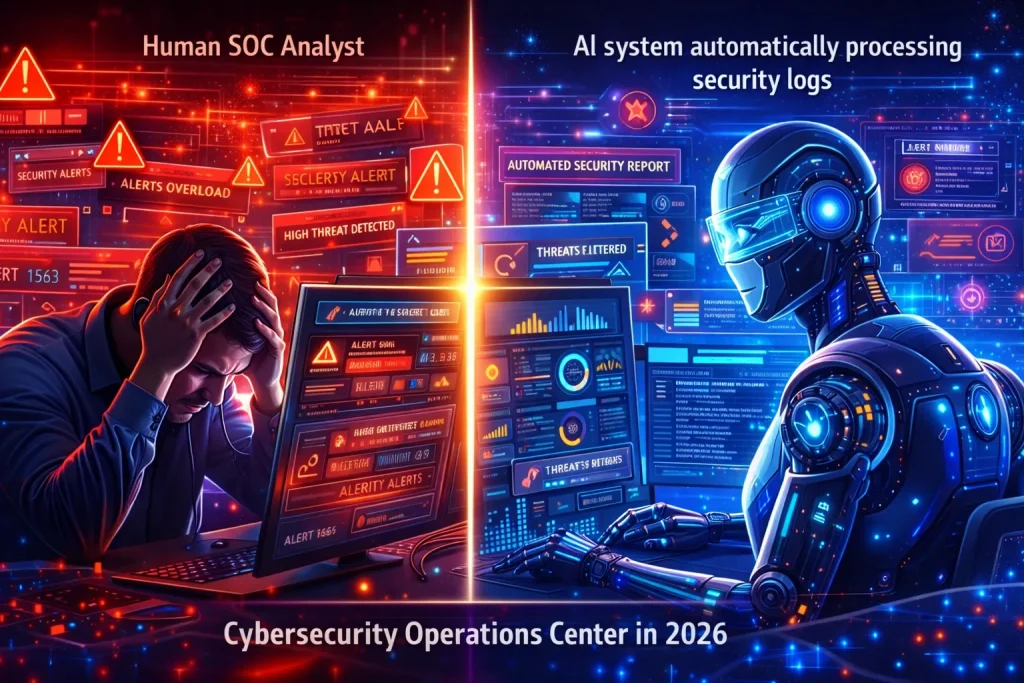
Tier 1 SOC Analysts (Alert Monitoring)
The most routine function in a Security Operations Center — watching dashboards and triaging Level 1 alerts — is already being automated at scale. AI systems now handle the initial filtering, correlation, and classification of alerts more reliably than junior analysts working overnight shifts.
This doesn’t mean SOC jobs are disappearing. It means the entry-level alert-watching portion of the role is. The analysts who adapt by moving up the skill chain — to threat hunting, adversarial simulation, or incident command — remain in demand.
Compliance Report Writers
Generating standard compliance reports (SOC 2, ISO 27001, PCI DSS documentation) is increasingly handled by AI tools that pull audit logs, map controls to frameworks, and produce draft reports automatically. Human reviewers are still needed, but the volume of manual writing work has dropped sharply.AI is integrated into cybersecurity monitoring tools.
Basic Vulnerability Assessors
Running a vulnerability scanner and writing up the findings in a standard template? That’s largely automated. The human value now sits in contextual risk assessment — understanding what a vulnerability means for a specific business environment — not in running the scan itself.
Security Awareness Trainers (Generic Content)
AI platforms now generate phishing simulations, training modules, and security awareness content at scale. Generic security training that doesn’t require deep human facilitation is an increasingly automated function.
The Roles AI Is Making More Valuable
For every function that AI is streamlining, there are roles where the demand is accelerating precisely because AI has entered the picture. These are the positions worth building toward.
AI Security Engineers and Red Teamers
Organizations deploying AI systems face a completely new attack surface. AI models can be manipulated through prompt injection, data poisoning, adversarial inputs, and model inversion attacks. Security professionals who understand how to red team AI systems — testing them for exploitable weaknesses — are among the most sought-after in the industry right now.
This is a field that didn’t exist in its current form three years ago. It’s growing fast.
Threat Intelligence Analysts
AI generates massive volumes of threat data. The professionals who can interpret that data, contextualize it against specific industry threats, and translate it into actionable intelligence for business decision-makers are more valuable than ever. This role requires geopolitical awareness, industry knowledge, and strategic communication skills that no model currently replicates reliably.
Cloud Security Architects
As AI workloads move into cloud infrastructure — and as organizations scramble to secure the large language models, APIs, and data pipelines powering their AI applications — cloud security architects are in extraordinary demand. These professionals design security controls at the infrastructure level, requiring deep technical expertise combined with architectural thinking.
Incident Commanders and Crisis Managers
When a major breach happens — when ransomware locks down a hospital, when a supply chain attack compromises thousands of organizations simultaneously — AI doesn’t step in to manage stakeholder communication, coordinate regulatory response, or make judgment calls under pressure. Experienced incident commanders do.
Leadership under fire is irreplaceable by automation.
Penetration Testers and Ethical Hackers
Creative offensive security work is genuinely hard for AI to replicate. A skilled penetration tester doesn’t follow a script — they think like an adversary, chain seemingly minor vulnerabilities together, and find paths that automated scanners miss entirely. Human creativity in offensive security remains a competitive advantage.
Security Governance, Risk, and Compliance (GRC) Specialists
GRC work involves navigating regulatory complexity, managing organizational risk posture, and translating technical findings into boardroom language. These functions require human judgment, legal literacy, and stakeholder management skills. AI assists with documentation; it doesn’t think.
How AI Is Changing the Day-to-Day Reality of Security Work
For professionals currently in the field, AI isn’t replacing jobs so much as it’s reshaping what those jobs look like.
The alert fatigue problem is improving. SOC analysts who were previously drowning in thousands of daily alerts are now reviewing a curated subset of genuinely suspicious activity. For many, this has made the job more sustainable — not redundant.
The speed expectation has changed. Clients and executives now expect faster detection, faster response, and more comprehensive reporting. AI tools raise the floor of what “adequate” security looks like, which raises the bar for human practitioners too.
Junior roles look different. The traditional “pay your dues doing manual work” entry point into security has shifted. Junior professionals who want to grow need to develop AI fluency — understanding how to configure, tune, and interrogate AI security systems — rather than simply logging alerts.
Senior roles require more translation. Security leaders increasingly spend time translating AI system outputs into business risk language. The ability to bridge technical AI findings and executive decision-making is a premium skill in 2026.
What Adversaries Are Doing with AI (And Why Human Defenders Matter More)
Here’s the dimension of this conversation that often gets overlooked: attackers are using AI too.
AI-powered phishing campaigns now generate personalized spear-phishing emails at scale, tailored to individual targets using publicly available data. AI is being used to discover and exploit vulnerabilities faster than traditional methods. Deepfake audio and video are being used in social engineering attacks against financial institutions and executives.
The threat landscape isn’t staying static while defenders automate their detection. It’s accelerating. And responding to novel, adaptive, AI-augmented threats requires human intelligence, creativity, and judgment — the exact qualities that make experienced security professionals irreplaceable.
Every time AI makes defense more efficient, it also raises the ceiling of what attackers can attempt. The arms race doesn’t eliminate the need for human defenders. It intensifies it.
What Decision-Makers Need to Understand
If you’re a CISO, security team lead, or organizational decision-maker reading this, the temptation to over-invest in AI tooling while under-investing in human talent is a genuine strategic risk.
AI security tools are most effective when they’re paired with skilled practitioners who can tune them, interpret their outputs, investigate the findings they surface, and respond to the incidents they flag. Deploying AI without the human expertise to leverage it is like installing an advanced alarm system with no one monitoring the alerts.
The organizations getting the best security outcomes in 2026 are those treating AI as a force multiplier for skilled teams — not a substitute for them.
Practical recommendations for security leaders:
- Audit which roles in your team are doing high-volume, repeatable work, and invest in AI tools to free them up for higher-value tasks
- Prioritize upskilling existing staff on AI security tools rather than replacing headcount
- Begin building capability around AI security, specifically — model security, LLM threat modeling, and AI governance
- Resist the boardroom pressure to reduce security headcount because “AI handles it now” — this is a misunderstanding of where the technology actually stands
What Security Professionals Should Do Right Now
If you’re a security professional concerned about your career trajectory, here’s actionable guidance rather than generic reassurance.
Develop AI Fluency — Not Just Familiarity
Understanding that AI tools exist isn’t enough. You need to understand how they work, where they fail, and how to extract maximum value from them. Learn how to tune SIEM models, interpret ML-based detection outputs, and evaluate AI-generated threat intelligence critically.
Specialize in Areas AI Struggles
Move toward roles that require creativity, judgment, communication, and adversarial thinking. Penetration testing, threat intelligence, incident command, and AI security engineering are all areas where human expertise commands a premium.
Build the Business Communication Skill
The security professionals who thrive in an AI-augmented environment aren’t just technically excellent — they can translate findings into business impact, speak to executives in risk language, and drive organizational decision-making. This skill has always mattered; it now matters more.
Understand AI as an Attack Surface
Pursue education in adversarial machine learning, prompt injection, AI red teaming, and model security. These are 2026’s fastest-growing security specializations, and they’re almost entirely dependent on human expertise.
Pursue Certifications That Reflect the New Landscape
Look for credentials that acknowledge AI’s role in security — from updated SANS courses on AI and security operations to emerging certifications from ISC2 and ISACA focused on AI governance and risk.
Don’t Wait for Your Role to Change Around You
Proactively expand your skill set before automation reaches the parts of your current role. The professionals who adapt early set the terms; those who wait are left negotiating them.
The Verdict: Replacement or Transformation?
After examining the evidence — workforce data, technological capability, threat landscape evolution, and organizational reality — the conclusion is clear.
AI is not replacing cybersecurity professionals. It is transforming what cybersecurity work looks like and raising the bar for what professionals need to bring to the table.
The roles most vulnerable to AI are the ones defined by volume, repetition, and rule-following. The roles becoming more valuable are defined by judgment, creativity, communication, and expertise. That’s not a story about displacement — it’s a story about elevation.
The cybersecurity professionals who will struggle in the next five years are those who treat AI as a threat to ignore or a tool to passively use. Those who will thrive are the ones who develop genuine fluency with AI systems, specialize in areas where human expertise is genuinely irreplaceable, and position themselves as the intelligence layer on top of the automation.
The talent gap isn’t closing. The adversaries aren’t slowing down. The stakes aren’t getting lower. Skilled cybersecurity professionals aren’t becoming less necessary — they’re becoming more necessary, in ways that are harder to fill and harder to automate.Start your journey with best laptops for cybersecurity.
Your Next Move
The cybersecurity field in 2026 rewards professionals who stay ahead of the curve, not those who react to it after the fact. If this article has surfaced questions about your career trajectory, your team’s readiness, or your organization’s security posture in an AI-shaped landscape — that’s exactly the right reaction.
Start with one concrete step: identify the part of your current role most likely to be automated in the next 24 months, and begin building the skill that makes you valuable when that automation arrives.
The professionals who ask this question early are the ones who answer it on their own terms.


