Top 12 Cybersecurity Monitoring Tools to Protect Your Network in 2026
The average time to detect a breach in an enterprise environment is still measured in days, not hours. In that window, attackers move laterally, escalate privileges, exfiltrate data, and establish persistence. By the time an alert surfaces, the damage is already compounding.
In 2026, the threat landscape has grown measurably more sophisticated. AI-generated phishing campaigns, automated exploitation of vulnerabilities, and living-off-the-land attacks that blend seamlessly into legitimate traffic have rendered passive perimeter defenses functionally obsolete. What separates organizations that contain incidents quickly from those that spend months in recovery is one thing: the quality of their monitoring.If you’re new, start with cybersecurity vs software engineering.
This guide covers the top 12 cybersecurity monitoring tools that security and IT professionals are relying on in 2026, from enterprise SIEM platforms to open-source network analyzers, with honest assessments of what each tool does best, where it falls short, and who it’s built for.
If you’re evaluating your current stack, building out a SOC, or looking for gaps in your visibility, this is where to start.

What Makes a Cybersecurity Monitoring Tool Effective in 2026?
Before the list, a quick framework. Not all monitoring tools solve the same problem. Evaluating them without context leads to over-purchasing or buying tools that don’t fit your environment.
The best cybersecurity monitoring tools in 2026 deliver on these five dimensions:
- Coverage: Does it monitor the attack surfaces that matter — endpoints, network traffic, cloud workloads, identity systems, OT environments?
- Detection quality: Does it surface real threats with high fidelity, or drown analysts in false positives?
- Response integration: Can it trigger automated containment, or does it only alert?
- Scalability: Does it handle enterprise-scale telemetry without degrading performance?
- AI and behavioral analytics: Does it go beyond signature-based detection to identify novel and low-and-slow attacks?
Keep these criteria in mind as you evaluate. Let’s get into the tools.
1. Microsoft Sentinel — Best Enterprise SIEM for Cloud-Native Environments
Type: SIEM / SOAR | Deployment: Cloud (Azure-native)
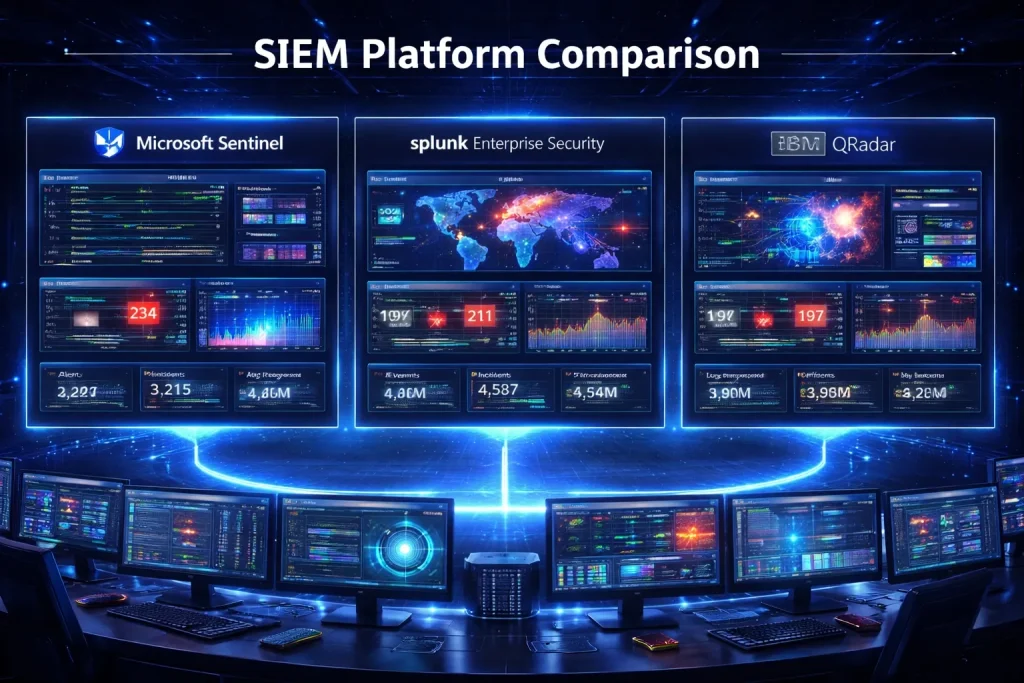
Microsoft Sentinel has cemented its position as the dominant cloud-native SIEM for enterprises running Microsoft infrastructure. Built natively on Azure, it ingests telemetry from Microsoft 365, Azure AD, Defender suite, and hundreds of third-party connectors — giving security teams a unified view across identity, endpoints, cloud, and network in a single interface.
What distinguishes Sentinel in 2026 is its deeply integrated AI layer. Microsoft Security Copilot integration means analysts can query incidents in natural language, generate investigation summaries, and surface correlated threat context at speed no manual process can match.
Standout Capabilities:
- Native integration across the entire Microsoft security ecosystem
- Built-in SOAR for automated playbook-driven response
- KQL-based threat hunting with prebuilt hunting queries from Microsoft’s threat intelligence team
- Pay-as-you-go pricing makes it scalable for both mid-market and enterprise
Best for: Organizations heavily invested in the Microsoft ecosystem that need a scalable, cloud-native SIEM with strong AI-assisted investigation.
Watch out for: Costs can escalate quickly with high data ingestion volumes. Careful log filtering and tiered storage are essential for cost management.
2. Splunk Enterprise Security — Best for Complex, Data-Heavy Environments
Type: SIEM | Deployment: On-premise / Cloud (Splunk Cloud)
Splunk remains the industry standard for organizations that need to ingest, correlate, and query massive volumes of machine data across complex, heterogeneous environments. Its SPL (Search Processing Language) query engine is unmatched in flexibility, and its ecosystem of apps and integrations covers virtually every security tool on the market.
In 2026, Splunk’s AI-driven anomaly detection and risk-based alerting framework has matured significantly. Rather than generating alerts per event, it aggregates risk scores across entities — users, devices, applications — and surfaces the investigations that actually warrant attention.
Standout Capabilities:
- Unrivaled data ingestion flexibility across on-prem, cloud, and hybrid environments
- Risk-Based Alerting (RBA) dramatically reduces alert fatigue
- Massive library of pre-built detection content from Splunk and the community
- Strong threat hunting capabilities for experienced analysts
Best for: Large enterprises with dedicated security engineering resources who need maximum customization and can leverage Splunk’s full depth.
Watch out for: High licensing costs and steep learning curve. Under-resourced teams often underutilize Splunk’s capabilities significantly.
3. CrowdStrike Falcon — Best EDR and Extended Detection Platform
Type: EDR / XDR | Deployment: Cloud-native SaaS
CrowdStrike Falcon is the benchmark for endpoint detection and response in 2026. Its lightweight agent architecture, cloud-delivered intelligence, and AI-powered threat detection have made it the tool of choice for organizations that need high-fidelity endpoint visibility without the overhead of on-premise infrastructure.
Falcon’s threat graph — which correlates billions of endpoint events globally in real time — gives it a detection advantage that on-premise tools structurally cannot replicate. When a new attack technique surfaces anywhere in CrowdStrike’s customer base, detection is updated globally within minutes.
Standout Capabilities:
- Industry-leading detection of novel malware and fileless attacks
- Managed threat hunting via CrowdStrike Overwatch (optional service)
- Falcon X threat intelligence is integrated directly into investigation workflows
- Minimal performance impact on protected endpoints
Best for: Organizations prioritizing endpoint protection with real-time threat intelligence and optional managed detection capabilities.
Watch out for: Premium pricing. Organizations on tight budgets may find the full Falcon suite difficult to justify without a clear ROI case.

4. Darktrace — Best for AI-Driven Anomaly Detection
Type: NDR / AI Security Platform | Deployment: On-premise / Cloud / SaaS
Darktrace’s approach to network monitoring is fundamentally different from signature or rule-based tools. Its Self-Learning AI builds a dynamic model of normal behavior for every user, device, and connection in your environment — and flags deviations from that baseline in real time.
This behavioral approach makes Darktrace particularly effective at catching novel threats, insider activity, and subtle lateral movement that rule-based systems miss entirely. In 2026, Darktrace’s Autonomous Response capability (Antigena) can take proportionate, targeted containment actions automatically — slowing or blocking suspicious connections while keeping normal operations running.
Standout Capabilities:
- Unsupervised machine learning requires no predefined rules or signatures
- Effective against zero-day attacks and insider threats
- Autonomous response capability for real-time containment
- Coverage across network, cloud, email, and OT environments
Best for: Organizations that want AI-native behavioral detection without building and maintaining complex rule libraries.
Watch out for: The “black box” nature of its AI can make it challenging to explain detections to compliance teams or auditors. Tuning for low false positive rates requires investment in the first few months post-deployment.

5. Wireshark — Best Open-Source Network Protocol Analyzer
Type: Network Traffic Analyzer | Deployment: On-premise (free, open-source)
Wireshark needs no introduction among security professionals. The world’s most widely used network protocol analyzer remains an indispensable tool in 2026 — not because it’s the most automated, but because nothing else gives you this level of granular visibility into what’s actually moving across your network.
For packet-level forensic investigation, malware traffic analysis, protocol debugging, and hands-on threat hunting, Wireshark is irreplaceable. No enterprise tool gives you the raw transparency that Wireshark provides.
Standout Capabilities:
- Deep inspection of hundreds of protocols
- Powerful display and capture filters for targeted analysis
- Export capabilities for integration with other analysis tools
- Completely free and actively maintained by the open-source community
Best for: Security analysts, forensic investigators, and network engineers who need deep packet inspection capabilities for investigation and research.
Watch out for: Not a real-time monitoring or alerting tool. Wireshark is a manual analysis instrument, not an automated detection platform. It requires analyst expertise to extract value.

6. Elastic Security (ELK Stack) — Best Open-Source SIEM Alternative
Type: SIEM / Log Management | Deployment: Self-hosted / Elastic Cloud
The Elastic Stack — Elasticsearch, Logstash, and Kibana, now unified under Elastic Security — has become a legitimate enterprise SIEM alternative for organizations that want SIEM-grade capabilities without Splunk’s licensing costs.
Elastic Security ingests and correlates logs at scale, includes prebuilt detection rules mapped to MITRE ATT&CK, and supports machine learning-based anomaly detection. Its open architecture gives security engineers the flexibility that commercial platforms often restrict.
Standout Capabilities:
- High-performance log ingestion and search at scale
- Detection rules library aligned to MITRE ATT&CK framework
- Integrated endpoint agent (Elastic Agent) for EDR capabilities
- Significantly lower cost than commercial SIEM alternatives
Best for: Security engineering teams with the technical capability to manage and tune the stack, and organizations looking for cost-effective SIEM functionality.
Watch out for: Self-hosted deployments require meaningful engineering investment for setup, maintenance, and tuning. It’s not a “deploy and forget” solution.
7. Tenable Nessus / Tenable.io — Best Vulnerability Management Platform
Type: Vulnerability Scanner / Management | Deployment: On-premise / Cloud SaaS
You can’t protect what you don’t know is exposed. Tenable’s vulnerability management platform remains the standard for continuous asset discovery and vulnerability assessment in 2026. Tenable.io’s cloud-delivered approach provides continuous visibility into vulnerabilities across IT, cloud, OT, and web applications from a single platform.
Its integration with threat intelligence feeds means Tenable can prioritize vulnerabilities not just by CVSS score, but by actual exploitation activity in the wild — a critical distinction when you have 10,000 open vulnerabilities and resources to patch 200 this week.
Standout Capabilities:
- Industry-leading vulnerability coverage with 80,000+ plugins
- Predictive prioritization using threat intelligence and exploit likelihood
- Continuous cloud asset discovery for dynamic environments
- Strong OT/ICS scanning capabilities via Tenable OT
Best for: Organizations that need comprehensive, continuous vulnerability visibility across complex, multi-environment infrastructure.
Watch out for: Vulnerability scanning without a mature remediation process downstream produces reports that no one acts on. Tenable is most effective when paired with strong patch management workflows.
8. Palo Alto Networks Cortex XDR — Best for Unified Threat Detection Across All Vectors
Type: XDR | Deployment: Cloud SaaS
Cortex XDR from Palo Alto Networks delivers extended detection and response across endpoint, network, cloud, and identity data — stitching together telemetry that siloed tools leave disconnected. Its causality-based detection engine builds attack storylines automatically, showing analysts the full chain of an attack rather than individual alerts.
In 2026, Cortex XDR’s integration with Palo Alto’s broader security platform (Prisma Cloud, Panorama, AutoFocus) makes it a compelling choice for organizations standardizing on the Palo Alto ecosystem.
Standout Capabilities:
- Cross-platform detection correlating endpoint, network, and cloud telemetry
- Automated root cause analysis and attack storyline visualization
- Behavioral analytics to detect credential abuse and insider threats
- Strong integration with Palo Alto firewall and cloud security infrastructure
Best for: Organizations invested in the Palo Alto security platform that want unified detection and response without managing multiple disconnected tools.
Watch out for: Maximum value requires deploying multiple Palo Alto products. Organizations with mixed-vendor environments may find integration more complex.

9. SolarWinds Security Event Manager — Best Mid-Market SIEM
Type: SIEM | Deployment: On-premise / Cloud
SolarWinds Security Event Manager (SEM) targets the mid-market segment that needs legitimate SIEM capabilities without the complexity and cost of enterprise platforms. It provides real-time log correlation, automated threat response, compliance reporting, and a user-friendly interface that doesn’t require a dedicated SIEM engineer to operate.
For IT teams that wear multiple hats and can’t dedicate headcount to managing a complex security stack, SEM offers a practical balance of capability and manageability.
Standout Capabilities:
- 700+ prebuilt correlation rules covering common attack scenarios
- Automated response actions to contain threats without manual intervention
- Built-in compliance reporting for PCI DSS, HIPAA, SOX, and others
- Simple deployment and intuitive UI compared to enterprise competitors
Best for: Mid-sized organizations that need SIEM functionality without the operational overhead of platforms like Splunk or Sentinel.
Watch out for: Scalability limits become apparent at enterprise data volumes. Organizations that grow quickly may outpace SEM’s capabilities.
10. Zeek (formerly Bro) — Best Open-Source Network Security Monitor
Type: Network Security Monitoring | Deployment: On-premise (free, open-source)
Zeek is a passive network traffic analyzer that generates detailed, structured logs of network activity — DNS queries, HTTP transactions, SSL connections, file transfers, and more — without requiring signature-based rules. It’s the foundation of network security monitoring for countless security teams and research institutions globally.
Unlike Wireshark, which captures raw packets for manual analysis, Zeek produces high-level logs that are easy to query, correlate, and feed into SIEM platforms. It’s a foundational visibility tool that complements detection-focused platforms rather than replacing them.
Standout Capabilities:
- Rich, structured network logs covering all major protocols
- Highly extensible via custom scripts for specialized detection logic
- Integrates natively with Elastic, Splunk, and other SIEM platforms
- Completely free, with an active research and development community
Best for: Security teams that need deep network visibility and are comfortable operating open-source tooling, particularly in research, education, and security-mature enterprise environments.
Watch out for: Requires network engineering expertise to deploy and maintain effectively. Not a plug-and-play solution for teams without dedicated network security resources.
11. IBM QRadar — Best for Compliance-Driven Enterprise Environments
Type: SIEM | Deployment: On-premise / Cloud / SaaS
IBM QRadar has been an enterprise SIEM staple for over a decade, and in 2026, it remains a strong choice for large organizations with complex compliance requirements — particularly in regulated industries like financial services, healthcare, and government.
QRadar’s offense management system automatically correlates events, flows, and vulnerabilities to generate prioritized offenses — giving analysts a focused investigation queue rather than a raw alert stream. Its deep library of compliance content and prebuilt apps covers virtually every regulatory framework.
Standout Capabilities:
- Mature network flow analysis alongside traditional log management
- Strong compliance framework coverage out of the box
- App Exchange with extensive third-party integrations
- IBM Threat Intelligence integration for enriched detection
Best for: Large enterprises in regulated industries with existing IBM infrastructure relationships and strong compliance reporting requirements.
Watch out for: QRadar’s interface and query language have a steep learning curve. Deployment complexity is high, and the platform performs best with dedicated SIEM administration resources.
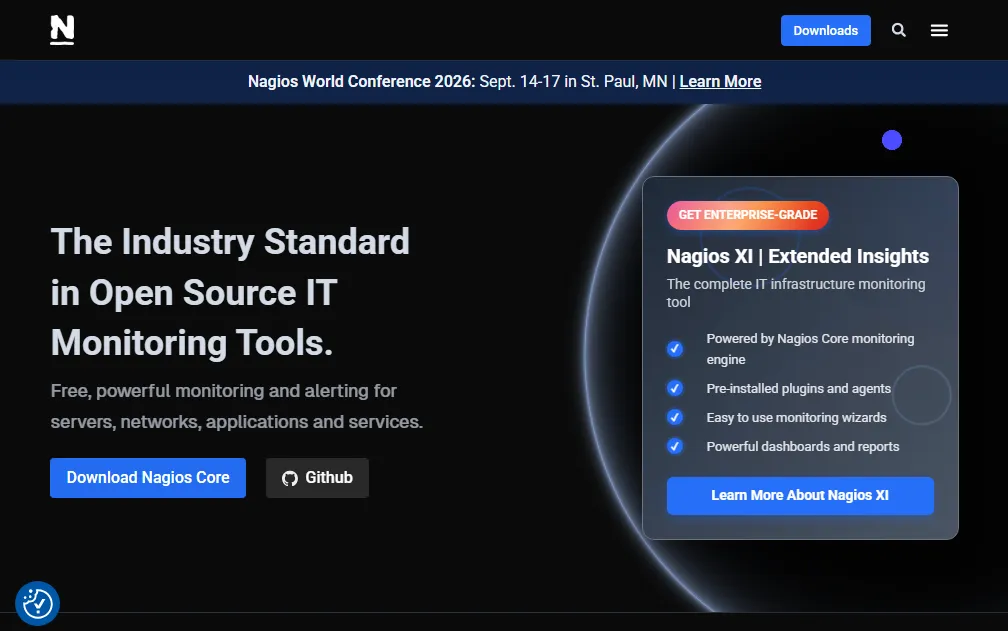
12. Nagios — Best for Infrastructure and Network Availability Monitoring
Type: Infrastructure / Network Monitor | Deployment: On-premise (open-source and commercial)
Nagios occupies a different niche than the security-focused tools on this list. It’s fundamentally an IT infrastructure monitoring platform — tracking server uptime, service availability, network device health, and performance metrics. But in a security context, availability monitoring is security monitoring.
DDoS attacks, ransomware-induced outages, and network device failures all surface in Nagios before they surface in security tools. For organizations that need to correlate security incidents with infrastructure impact — or that need a cost-effective baseline monitoring capability — Nagios remains a practical choice.
Standout Capabilities:
- Comprehensive server, network, and application availability monitoring
- Highly extensible with thousands of community plugins
- Alerting and escalation workflows for operational incident management
- Nagios XI (commercial) adds enterprise dashboards and reporting
Best for: IT and operations teams that need infrastructure health monitoring alongside security tooling, particularly in on-premise and hybrid environments.
Watch out for: Nagios is not a security detection tool and should not be treated as one. It complements a security monitoring stack — it doesn’t replace any element of it.
Quick Comparison: Choosing the Right Tool for Your Environment
| Tool | Type | Best Fit | Deployment | Cost |
| Microsoft Sentinel | SIEM/SOAR | Microsoft-heavy enterprises | Cloud | Pay-per-use |
| Splunk Enterprise Security | SIEM | Large, data-intensive enterprises | On-prem / Cloud | High |
| CrowdStrike Falcon | EDR/XDR | Endpoint-focused organizations | Cloud SaaS | Premium |
| Darktrace | NDR/AI | AI-native behavioral detection | On-prem / Cloud | Premium |
| Wireshark | Packet Analyzer | Forensics and manual analysis | On-prem | Free |
| Elastic Security | SIEM | Cost-conscious security teams | Self-hosted / Cloud | Low–Mid |
| Tenable.io | Vulnerability Mgmt | Continuous vulnerability visibility | Cloud SaaS | Mid–High |
| Cortex XDR | XDR | Palo Alto ecosystem users | Cloud SaaS | Premium |
| SolarWinds SEM | SIEM | Mid-market organizations | On-prem / Cloud | Mid |
| Zeek | NSM | Network visibility and research | On-prem | Free |
| IBM QRadar | SIEM | Regulated industries | On-prem / Cloud | High |
| Nagios | Infrastructure Monitor | IT ops and availability monitoring | On-prem | Free / Mid |
How to Build a Monitoring Stack That Actually Works
Selecting individual tools is only half the challenge. How you integrate them determines whether your monitoring capability is genuinely effective or just expensive and siloed.
Layer your coverage intentionally. No single tool covers every attack surface. Most mature security stacks combine a SIEM (for log correlation and investigation), an EDR/XDR (for endpoint and cross-vector detection), a network monitoring tool (for traffic visibility), and a vulnerability management platform (for exposure awareness).
Don’t let data pile up without process. The most common failure mode in cybersecurity monitoring isn’t insufficient tooling — it’s insufficient process. Tools generate data. Analysts generate investigations. Document your triage procedures, define escalation paths, and establish response playbooks before adding more tools to the stack.
Tune relentlessly. Out-of-the-box detection rules are a starting point, not a finish line. Every environment is different. The teams that get the most from their monitoring tools invest ongoing effort in reducing false positives, adding custom detection logic, and refining alert thresholds based on their specific threat model.
Measure what matters. Track mean time to detect (MTTD) and mean time to respond (MTTR) as your primary monitoring effectiveness metrics. If your tooling investments aren’t moving these numbers in the right direction, something needs to change.These tools are used in cybersecurity staffing solutions.
Final Thoughts: Visibility Is Your Most Valuable Security Asset
The tools on this list represent the best of what’s available in 2026 across different categories, budgets, and deployment models. But the most important insight isn’t about any specific tool — it’s about the principle that underpins them all.
You cannot defend what you cannot see.
Adversaries count on blind spots. They move through unmonitored network segments, abuse accounts with no behavioral baselining, and exploit vulnerabilities in assets you didn’t know existed. Every gap in your monitoring coverage is an opportunity for an attacker.
The organizations that contain incidents in minutes rather than days don’t necessarily have the most expensive tools. They have the right tools, properly tuned, operated by skilled practitioners with clear processes — and they’ve invested in visibility as a first principle, not an afterthought.Students should also check best laptops for cybersecurity students.